Champagne Drappier: A blend of old-world charm and modern innovation
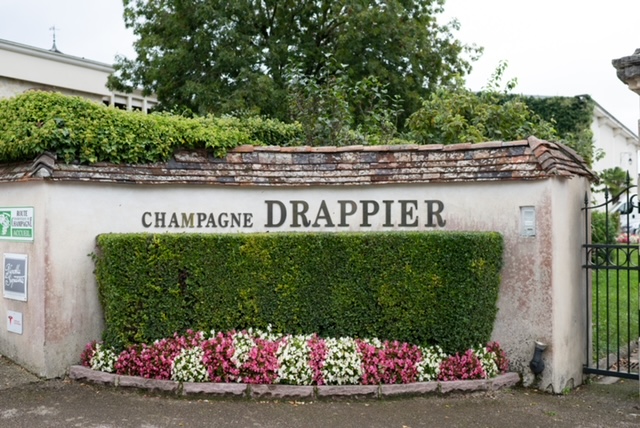
My journey to Champagne Drappier was not just about tasting the renowned cuvées but also about delving into the rich tapestry of history and innovation that defines Champagne Drappier. At the heart if the House, located in the southernmost part of Champagne region, in a place called Urville, are its people. Three generations, each embodying the legacy and forward-thinking spirit of their esteemed house. From the wisdom and experience of the elder Drappier to the dynamic vision of the younger members, it was clear that their passion for champagne transcends generations. As I spent time with the family, our conversations flowed as smoothly as the champagne itself, revealing stories of tradition, meticulous artisanry, and a relentless pursuit of excellence and innovation. It was fascinating to experience and appreciate the interplay between tradition and innovation at Champagne Drappier which creates a unique dynamic.
We stopped off in Paris for lunch with Charline Drappier, part of the 8th generation who leads on all their communications and marketing activities. Her keen eye for detail and modern marketing strategies are helping to expand the brand’s reach while maintaining its prestigious image. Her introduction to Drappier started with 3 generations of champagne.
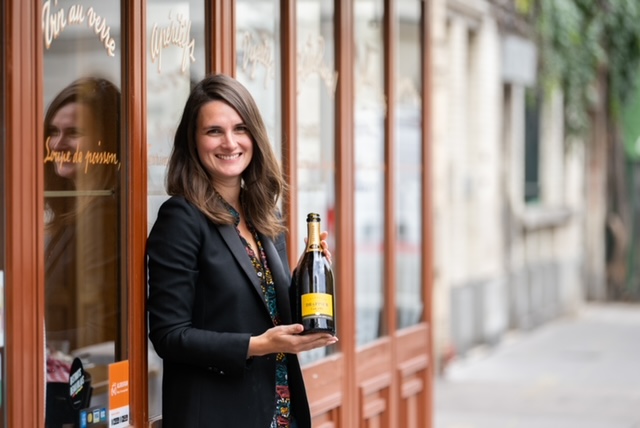
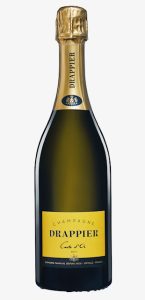
Carte d’Or, a Micheline and André Drappier (6th generation) creation is a blend of Pinot Noir (80%), Chardonnay (15%) and Meunier (5%), taking the base wine of 2020 and disgorging in February 2024. “Almost a Blanc de Noirs, with quinze notes”, which explains the yellow label. This is full of stone fruits, it’s intense, generous, and a dosage of 5g/l. Charline explains that they’ve been lowering dosage each year, “tastes are changing, getting closer to our zero dosage”.
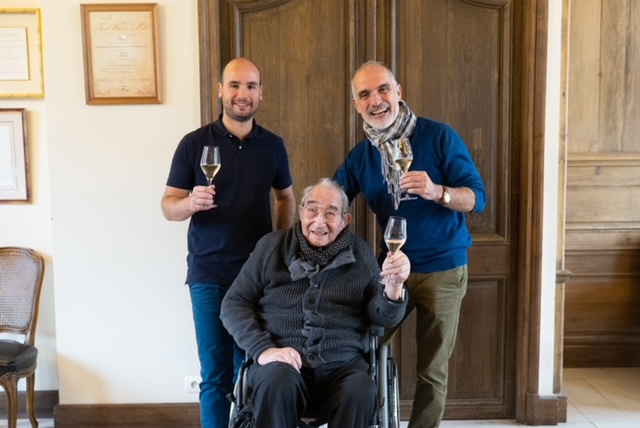
André Drappier, the patriarch of the family, still plays a cherished role despite his advanced age. At 97, he joins the family for lunch every day and enjoys his first glass of Drappier’s Carte d’Or label at 11 am. It was an absolute pleasure to enjoy a lunchtime glass of champagne with him – his presence is a living reminder of the house’s rich history and the values that have been passed down through generations.
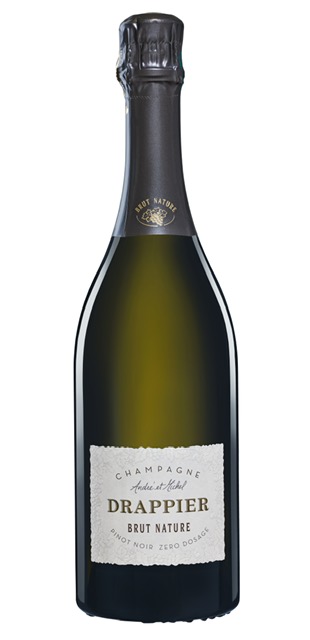
Brut Nature, created by 7th generation, Michel Drappier, is 100% Pinot Noir, the grape that prevails here, representing 70% of the estate (supplemented by Pinot Meunier at 15%, Chardonnay at 9%, and old grape varieties at 6%). Michel Drappier, the current head of the house, is the driving force behind many of the innovative practices that have been introduced. His expertise in winemaking and his forward-thinking approach have helped elevate the quality and sustainability of their champagne.
Here Michel has created a Blanc de Noirs with zero dosage. It’s a truly gastronomic wine, a very pure expression of the terroir. Finesse, freshness and ripeness are key for Brut nature. And “the use of an absolute minimum of sulphur gives the wine the freedom to express itself totally.” A number of the Drappier family are allergic to sulphur, therefore the majority of their wines see minimal presence.
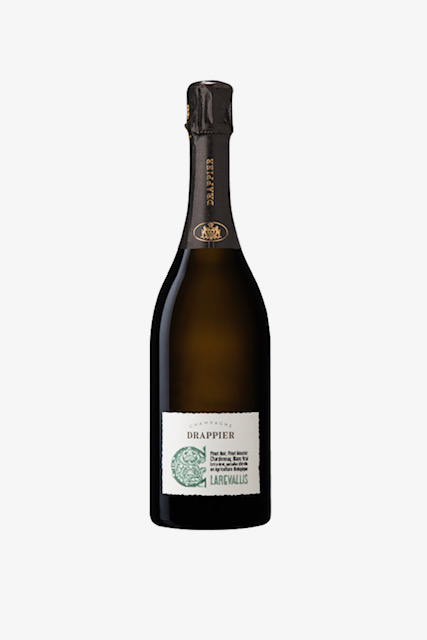
Clarevallis, an 8th generation creation, made by Charline, Hugo and Antoine. Hugo is responsible for viticulture and oenology. His role involves overseeing the vineyards and ensuring that the winemaking process adheres to the highest standards of quality and sustainability.
Produced from a blend of Pinot Noir (75%), Pinot Meunier (10%), Chardonnay (10%) and Blanc Vrai (5%) with a dosage of 4g/l. The base is 2017, with 4 years on the lees which has softened the high acidity and bitterness, bringing structure to the wine.
Clarevallis is inspired the name given by Saint Bernard to the abbey he founded and is made with grapes from the Urville hillsides, organically farmed, planted during the Cistercian period.
Tradition and experimentation
All seven permitted grape varieties are grown here, which is quite rare (Arbanne, Petit Meslier, Blanc Vrai, Fromenteau, Chardonnay, Pinot Noir and Pinot Meunier) and they are the first house to plant the 8th grape variety of champagne – Voltis. A new grape variety recently approved for champagne production (on a trial basis). Voltis is a hybrid variety known for its resistance to diseases, which makes it a sustainable choice for viticulture. By incorporating Voltis into their vineyards, Drappier is able to reduce the need for chemical treatments, aligning with their commitment to sustainable farming practices.
Whilst under his stewardship, Andre spent time removing Arbanne, Michel and Hugo are now on a mission to bring back the forgotten grapes and keep then alive for future generations. “Like renovating an old Church, you keep the history”. We gained a deeper understanding of these ‘Ancient Grape’ varieties during our pre-lunch during Masterclass:
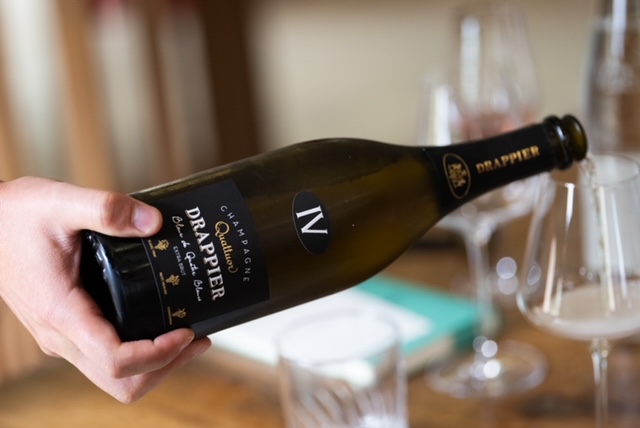
Quattuor – Blanc de Quatre Blancs is produced using 25% of each of the four white grapes. The first one is actually a 2019 single vintage, but presented as a non-vintage as Michel does not wish to be restricted by time spent on the lees. Next up was the first edition of Quattuor, the base is the 2004 vintage and is beatifically aged with 10 years on the lees and a further 10 years in bottle. In comparison to the 2019, its nuttier, there’s a lovely creaminess and a citrus finish.
Père Pinot 2, explained Hugo, “is named after our Grandfather George, affectionately known as “Père Pinot,” as he was a pioneering winemaker who championed the replanting of Pinot Noir in the Aube region”. The “Père Pinot” journey began in 2016 when the three children of the 8th generation (Hugo, Charline and Antoine), joined the family estate. “With this ‘family wine’, we delve into our family’s rich winemaking heritage with a sense of great freedom.”
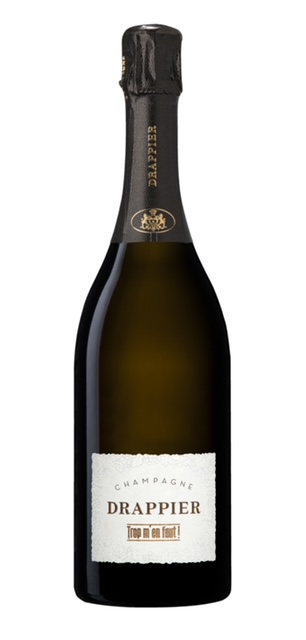
With ‘Trop M’en Faut!’ they’re bringing back the essence of traditional wines with 100% Fromenteau, also known as Pinot Gris in Champagne. This grape, with its distinctive copper hue, was once a staple in the Aube region’s robust wines but has now become a rarity. Fromenteau offers a rich, silky, and ample profile, resulting in a golden wine with delicate fruit notes. The Drappier family places great importance on single varietal wines without added sugar, making Trop m’en Faut! a natural choice for a Brut Nature.
Michel explained that “Trop m’en faut is a playful twist on the sounds of Fromenteau, inspired by Rabelais’ sixteenth-century wordplay. This charming phrase can be loosely translated to mean, ‘So good that you can never get enough.’”
The Fromentau grapes come from vineyards ploughed by horse. Antoine Drappier brings a touch of tradition to the estate with his passion for animals and nature. He cultivates a portion of the vineyard using a horse-drawn plough, a practice that harks back to the old ways of farming and highlights the family’s commitment to sustainable agriculture.
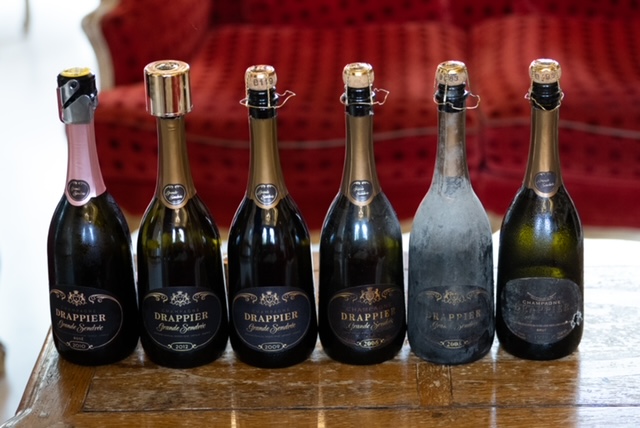
Grande Sendrée
On the second day of our visit a delightful was made by Sylvie Drappier, Michel’s wife and accompanied by a vertical tasting (2012, 2009, 2008, 2006, 1999) of Grande Sendrée, a vintage only developed when the wine reaches its ultimate potential. “Cuvée Sendrée” was actually the result of a spelling mistake. The intended name was “Cuvée Cendrée,” which means “ash” in French, referencing the ashes from the fire that devastated Urville in 1836. Despite the error, the name stuck and has become a distinctive part of Champagne Drappier’s history and branding.
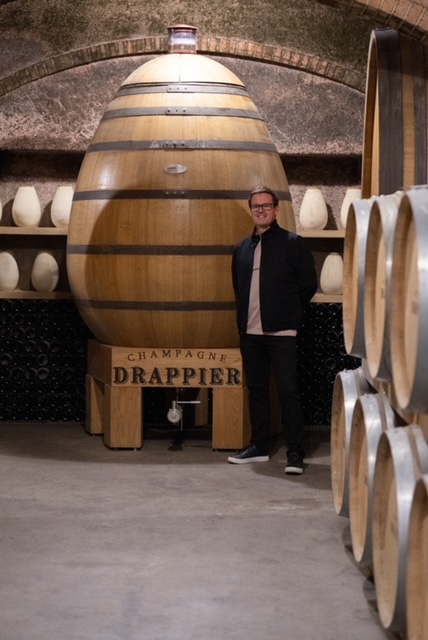
The Ovum, a pioneering creation in the Champagne region, is used to age the premium Grande Sendrée. Named after the Latin word for egg, is an extraordinary, egg-shaped oak vessel utilised by Champagne Drappier. This distinctive container has a capacity of 3.342 litres and was first introduced in 2012. Its design, inspired by the Golden Ratio, is considered ideal for wine maturation. The oak used to make the Ovum is sourced from the Aube region, the same area where Drappier’s vineyards are located.
This innovative vessel allows the wine to develop intricate flavours and aromas, significantly enhancing the quality of the Grande Sendrée. The use of the Ovum showcases Drappier’s dedication to blending traditional methods with modern innovation to produce exceptional Champagne.
Drappier’s attitude to innovation is endless, in 2016, they became the first “carbon neutral” estate in the region (Écoact). They are also unique in that they perform the secondary fermentation, known as “prise de mousse,” in all their bottle formats, including the very large ones like the Melchizedek (30 litres) and Primat (27 litres). This process involves riddling and disgorging each bottle individually, which is quite rare.
And in October 2002, they started experimenting with undersea ageing (Immersion) when bottles of Carte d’Or were immersed for 646 days in the English Channel, at a place called Ar Pommellou, a marine concession of the Drappier family. The idea here is we observe a slow-down in aging linked to a lower oxygen content in water than in air. When comparing it with the cellar aged Carte D’Or from the same year (2017 base with reserve from 2016 and 2015), it appeared more lively, energetic with youthful acidity.
There’s so much more I could tell you about Drappier, but I’ll save it for another day or my next visit. The Drappier’s are one of the most charismatic, hospitable families I have had the pleasure to spend time with and would urge you to try out their wines at Majestic Wines, Berkmann Wines, The Champagne Company, Champagne One, and VIVINO.